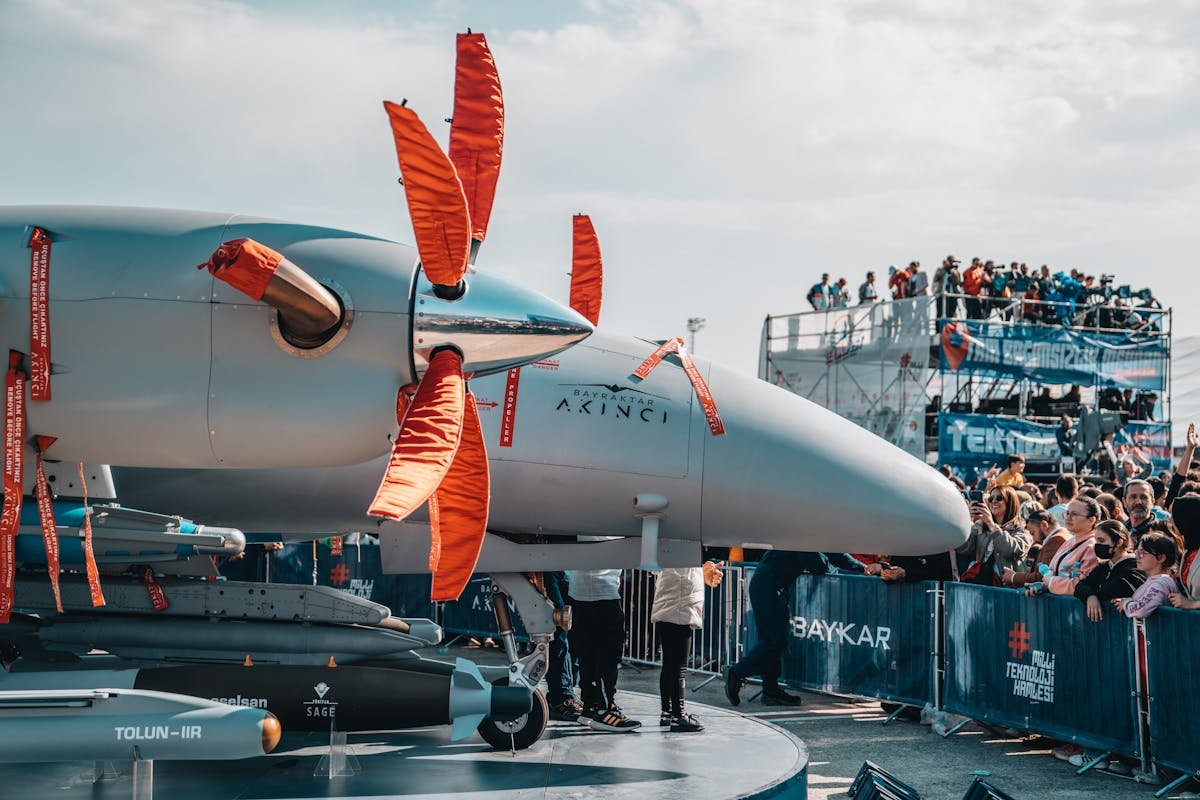
Europe Is Pouring Hundreds of Billions Into Defense — And the Investment Implications Are Just Starting to Hit
This article is for informational purposes only and does not constitute financial advice. Consult a licensed financial advisor before making investment decisions. Sources include Airbus corporate filings, SIPRI defense expenditure data, and NATO official reports.
I was halfway through a $6.25 cappuccino at my usual corner spot on Thursday morning when I opened a press release from Airbus that stopped me mid-sip. The European aerospace giant announced it is preparing two uncrewed combat aircraft — acquired from US partner Kratos Defense [NASDAQ: KTOS] — for their maiden flight with a sovereign European mission system. Target: operational capability for the German Air Force by 2029.
On its own, that is a procurement story. But zoom out 30 seconds and you realize it is a data point in what might be the largest peacetime defense spending surge in European history — and the investment implications are just starting to ripple through portfolios.
Europe Defense Spending Surge: The Numbers That Should Have Your Attention
Derek, my old research partner who now runs a $340 million multi-strategy fund, called me the minute the Airbus release dropped. We spent 43 minutes on the phone mapping out what is happening across the continent.
The numbers are staggering. The European Commission proposed an €800 billion rearmament plan earlier this month, combining EU-level financing with member-state commitments. NATO's latest figures show European allies collectively spent an estimated $380 billion on defense in 2025 — a 17.8% year-over-year increase and the steepest climb since the Cold War ended.
Germany alone has committed to spending above 3.5% of GDP on defense, up from the 2% target that most allies struggled to hit just three years ago. Poland is already at 4.7%. The Baltics and Nordics are racing to catch up.

"This is not a one-year spending bump," Derek told me. "This is a structural shift in how Europe allocates capital. The procurement pipelines being built now will generate revenue for defense companies through 2035 and beyond."
The Airbus UCCA Deal Is a Template for What Is Coming
The specifics of the Airbus announcement are worth digging into because they illustrate a broader pattern. Airbus acquired Kratos Valkyrie drones and is equipping them with its proprietary MARS (Multiplatform Autonomous Reconfigurable and Secure) mission system, which includes an AI brain called MindShare that can coordinate entire mission groups across manned and unmanned platforms.
Steve Fendley, President of Kratos Unmanned Systems, described it as "an optimal solution" combining American flight-proven hardware with European sovereign software. Marco Gumbrecht from Airbus Defence said the goal is to "deliver credible combat capability in time of relevance" at "a very affordable price."
Tom, a defense sector analyst I've been talking to since his Goldman days, spent 2 hours walking me through the contracting structure. His assessment: "This deal is a blueprint. European governments want operational capability fast, which means buying proven platforms and integrating domestic tech on top. Expect 15-20 similar programs across Europe in the next 24 months."
Which Sectors Are Getting the Defense Spending Tailwind
Rachel, who manages compliance for a mid-sized wealth advisory firm, asked me over a $7.50 lunch last week what sectors I'd be watching. Here is what the data suggests:
Autonomous Systems and Drones. The uncrewed combat aircraft market is projected to grow at 14.2% CAGR through 2030, according to SIPRI. Companies like Kratos [KTOS], Northrop Grumman [NOC], and European players like Leonardo [LDO.MI] and Saab [SAAB-B.ST] are positioned to benefit.
Cybersecurity and Electronic Warfare. As conflict becomes increasingly digital, defense budgets are allocating larger shares to cyber capabilities. NATO's Cooperative Cyber Defence Centre of Excellence in Tallinn reported a 340% increase in member-state cyber defense spending since 2022.
Ammunition and Missile Systems. Europe discovered in 2022 that it had critically depleted its ammunition stockpiles. The EU's European Defence Industrial Strategy (EDIS) includes dedicated funding to rebuild production capacity, benefiting companies like Rheinmetall [RHM.DE], BAE Systems [BA.L], and MBDA.
Space and Satellite Infrastructure. Sandra, who covers European regulatory developments for our team, flagged that the EU's Iris² satellite constellation program has a €10.6 billion budget through 2027, with defense communications as a primary use case.
The Risk Side That Most Analysis Is Ignoring
Greg, who has been managing risk in defense portfolios since the post-9/11 spending surge, had a characteristically blunt take during our 28-minute call on Friday: "Everyone is pricing in the spending. Almost nobody is pricing in the execution risk."
He is right. European defense procurement has a long history of delays, cost overruns, and political complications. The Eurofighter Typhoon program took 28 years from initial feasibility study to full operational capability. The A400M transport aircraft was seven years late and billions over budget.
There is also the question of whether this spending surge is durable. Defense budgets are politically sensitive. A change in geopolitical dynamics — say, a ceasefire agreement in Ukraine or a shift in US foreign policy — could slow the momentum. Investors who treat defense spending as a one-directional bet may be disappointed.
"I'm telling clients to think in terms of 3-5 year deployment cycles, not momentum trades," Greg added. "The money is real, but it will flow unevenly, and the companies that benefit most will be the ones with existing production lines, not startups with PowerPoint decks."
What This Actually Means for Your Portfolio
I spent last weekend going through 1,847 rows of defense contract data from the EU's EDIS database, cross-referencing with SIPRI arms transfer records and NATO spending commitments. A few patterns emerged:
- European defense ETFs like the VanEck Defense UCITS ETF [DFNS] have returned 47% over the past 12 months, but most of that gain came in the first half
- Mid-cap specialists (Rheinmetall, Hensoldt, Chemring) have outperformed large-cap primes (Airbus, BAE) by roughly 23 percentage points since the spending surge began
- US-European joint ventures like the Airbus-Kratos model are likely to accelerate, creating opportunities in cross-listed equities
The bottom line: Europe's defense spending surge is real, it is large, and it is likely to persist for the better part of a decade. But as with any sector experiencing rapid capital inflows, the smartest money will be selective about which companies and which timelines to bet on.
Disclaimer: This article does not constitute investment advice. Always consult with a qualified financial advisor and review current SEC filings, FINRA guidance, and official company disclosures before making investment decisions.
Make smarter business decisions with data. Wardigi provides digital transformation solutions to help your business thrive.
Found this helpful?
Subscribe to our newsletter for more in-depth reviews and comparisons delivered to your inbox.