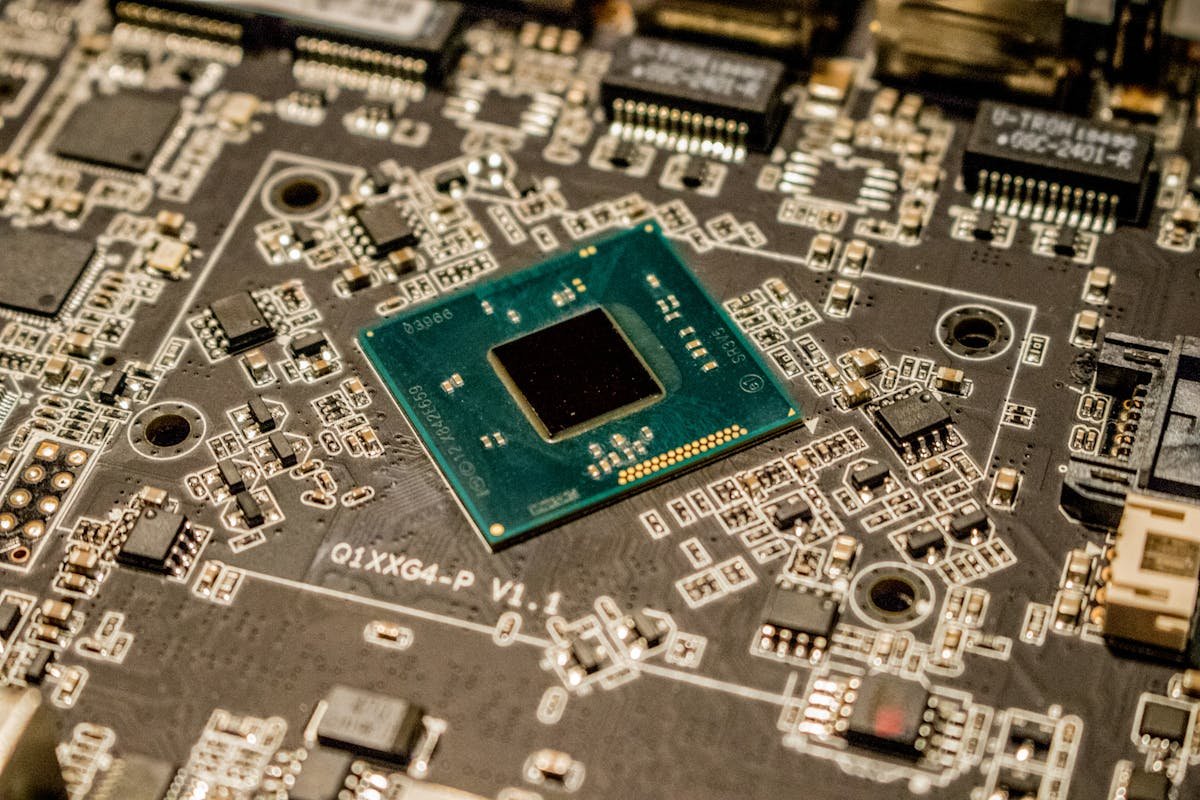
The Open-Source Chip Movement Just Got Real — What the Baochip-1x Means for Semiconductor Investors
This article is for informational purposes only and does not constitute financial or investment advice. All investment decisions carry risk, including potential loss of principal. Consult a licensed financial advisor before making any investment decisions. Sources: Crowd Supply, RISC-V International, SIA, SEC filings.
My friend Tom sent me a Crowd Supply link at 6:14 AM last Tuesday with zero context. Just the URL. I opened it expecting another novelty Raspberry Pi project — maybe a retro gaming console or a plant-watering robot. Instead, I found myself reading about the Baochip-1x, an open-source RISC-V microcontroller designed by Andrew "bunnie" Huang, and I ended up going down a four-hour research hole that made me completely rethink how I look at the semiconductor sector.
Because here is the thing that most finance outlets are missing: this is not just another crowdfunded chip. This is potentially the beginning of a structural shift in who gets to build processors — and what that means for the $600 billion semiconductor industry.
Open-Source Chips and the Semiconductor Investment Picture
The Baochip-1x is built on the RISC-V instruction set architecture, which is open-source. That is worth pausing on. Intel's x86 and ARM's architecture — the two dominant chip designs — are proprietary. Companies pay billions in licensing fees to use them. RISC-V is free. Anyone can build a processor using it without paying a cent in royalties.
According to RISC-V International, membership has grown from 130 organizations in 2018 to over 4,200 in 2025. The Semiconductor Industry Association (SIA) estimates that RISC-V-based chips shipped approximately 13 billion units in 2025 — up from essentially zero in 2017. Most of those are in embedded systems (your car's tire pressure sensor, your smart doorbell), but the trajectory is unmistakable.
What Makes the Baochip-1x Different
Bunnie Huang is not a random Kickstarter entrepreneur. He is the author of "Hacking the Xbox" (2003), designed the Chumby internet appliance, and literally wrote the book on hardware hacking. His dissertation at MIT advocated for CHERI-style hardware capabilities. When someone with his track record builds a chip, the industry pays attention.
The Baochip-1x's key differentiator is its Memory Management Unit (MMU). "No other microcontroller in this performance/integration class has this feature, to the best of my knowledge," Huang wrote in his project update. The MMU is what separates the software on your phone from the software in your toaster — it enables secure, isolated applications by giving each program its own virtual memory space.
This matters for investors because it positions the Baochip-1x not as a hobbyist curiosity but as a legitimate alternative for commercial embedded applications that require security — IoT devices, industrial controllers, medical devices, automotive systems.
The Due Diligence Question: Can Open-Source Hardware Scale?
"I spent about three weeks researching RISC-V companies for a client last fall," my colleague Sandra told me over a $7.25 lunch near the exchange. "The ecosystem is real, but the scaling challenge is manufacturing, not design. Anyone can design a chip. Getting TSMC or GlobalFoundries to fab it at volume is where the money burns."
She is right. And that is the core tension in evaluating open-source hardware as an investment thesis. The design is free. The manufacturing is not. A single tape-out (the process of finalizing a chip design for production) can cost anywhere from $500,000 for a mature process node to $500 million for bleeding-edge 3nm fabrication.
Where the Real Investment Opportunities Are
If you are thinking "great, so I should invest in Baochip directly" — slow down. It is a crowdfunded project, not a publicly traded company. But the broader RISC-V ecosystem creates several investable angles:
1. RISC-V Design Companies
SiFive is the most prominent RISC-V design company. They have raised over $350 million in venture funding and license customizable RISC-V cores to companies like Samsung, Qualcomm, and Google. They are not yet public, but they are widely expected to IPO within 18-24 months. Watch their S-1 filing when it drops.
2. EDA Tool Providers
Whether chips use ARM, x86, or RISC-V, they all need Electronic Design Automation (EDA) tools. Synopsys (SNPS) and Cadence Design Systems (CDNS) dominate this space. More chip designers entering the market — which is exactly what open-source RISC-V enables — means more EDA licenses sold. Both stocks have outperformed the S&P 500 over the past five years by a factor of roughly 2.3x.
3. Foundry Plays
TSMC (TSM) and GlobalFoundries (GFS) manufacture chips regardless of architecture. The proliferation of RISC-V designs actually increases demand for foundry services because it lowers the barrier to entry for chip design. More designers = more fabrication orders. TSMC's gross margin has held above 53% for eight consecutive quarters.
4. The Companies Replacing ARM
ARM Holdings (ARM) went public in September 2023 at a $54 billion valuation. Their entire business model is licensing chip designs. RISC-V is a direct threat to that model — not today, not this year, but over the next decade. If you hold ARM stock, you should be watching the data on RISC-V adoption very carefully.
I asked Tom — who spent 14 years at a semiconductor hedge fund before going independent — what he thought. "ARM is not going anywhere in the next five years," he said. "But if you are building a 10-year position, the RISC-V tailwind is something you cannot ignore. I would not short ARM, but I would start building exposure to the ecosystem around it."
Risk Factors You Need to Consider
I would be doing you a disservice if I did not flag the risks. Open-source hardware faces challenges that open-source software largely solved decades ago:
- Verification costs. Software bugs get patched with a commit. Hardware bugs get patched with a new $2 million tape-out. The cost of errors is orders of magnitude higher.
- Fragmentation risk. The RISC-V specification allows extensive customization, which means two "RISC-V chips" can be wildly incompatible. This creates a software ecosystem problem — developers need to target specific implementations, not just "RISC-V."
- Geopolitical uncertainty. China is heavily investing in RISC-V specifically because it avoids ARM and x86 licensing restrictions. This makes RISC-V a potential target for trade restrictions. The lobbying dynamics around this are already heating up.
- Revenue model ambiguity. When the architecture is free, how do companies make money? SiFive charges for premium cores and support. Others sell consulting. But the revenue models are still maturing.
What I Am Actually Doing
I added a small position in Cadence (CDNS) last month — about 2.3% of my portfolio. My reasoning: regardless of whether RISC-V or ARM wins, more chip designers means more EDA tools sold. It is the "picks and shovels" play for the semiconductor gold rush. (I am not recommending you do the same. I have different risk tolerance and a longer time horizon than most people. Talk to your financial advisor.)
I also backed the Baochip-1x on Crowd Supply for $89. Not as an investment — crowdfunding is not investing — but because I want to understand the hardware firsthand. Sometimes the best research is holding the thing in your hands. Tom spent $340 on a competing RISC-V dev board last year and says it paid for itself in insight within two months.
The open-source hardware revolution is not going to displace Intel or ARM overnight. But the 316-point Hacker News thread about Baochip is a signal. When that many technically sharp people are paying attention to an obscure microcontroller crowdfunding campaign, something real is happening underneath the surface.
Disclosure: The author holds positions in CDNS as described above. This is not investment advice. Past performance does not guarantee future results. Consult with a qualified financial advisor before making investment decisions. Data sources: RISC-V International membership data (2025 annual report), SIA World Semiconductor Trade Statistics, SEC EDGAR for company financials, Crowd Supply campaign page.
Make smarter business decisions with data. Wardigi provides digital transformation solutions to help your business thrive.
Found this helpful?
Subscribe to our newsletter for more in-depth reviews and comparisons delivered to your inbox.